Can I build a different, more exciting experience around a typical match-3 game?
The Match-3 genre usually features a slower paced gameplay. I set out to craft a more exciting experience around a typical match-3 experience.
Project's Design Goals
- Build a match-3 game that is not just a re-skin of existing match-3 games.
- Find a strong core gameplay loop using match-3 as the core mechanic.
- Show judgement in combining game mechanics, progression and pacing.
Deep Vein started as a match-3 roguelike prototype and has since grown into a short, playable match-3 roguelike experience. It has a mining theme set in an age-of-exploration aesthetic: the player is sponsored by the Gemmological Society to discover the hidden world of gems and minerals by digging through unexplored dungeons.
- Classic Match-3 Board Rules: Keeping a familiar core experience.
- Hidden Dungeon Layout: Evoke Curiosity: there's more than one place, what can I find next?
- Time Limit and Extraction: Create Tension: how can I maximise my score each run?
- Skill Tree, Collection and Saved Progress: Replayability: A reason to start another run.
1. Starts a run.
- Begin in a hidden dungeon layout with a countdown timer for your air supply.
2. Match gems
- Collected gems becomes accumulated currency (Carats).
3. Uncover new rooms as you match gems
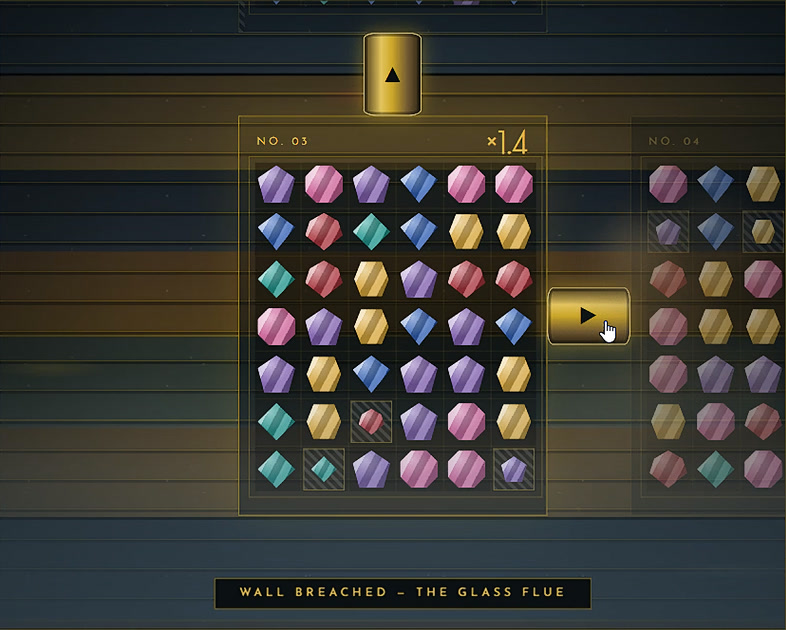
- Matching gems along a chamber's edge breaches the wall. If the hidden layout has a room there, it reveals and a connector tube lets you travel to it. If not, the wall stays a wall.
4. Extract collected gems
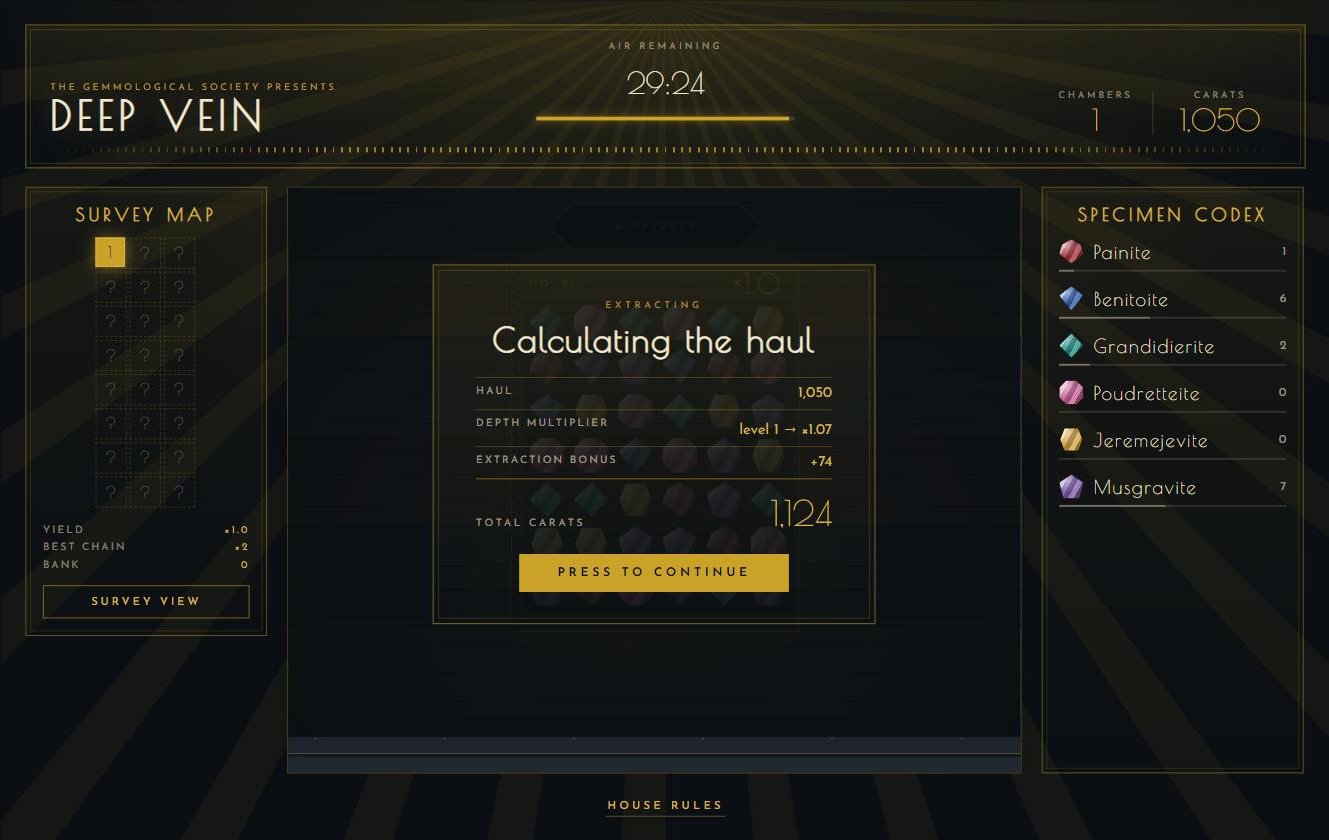
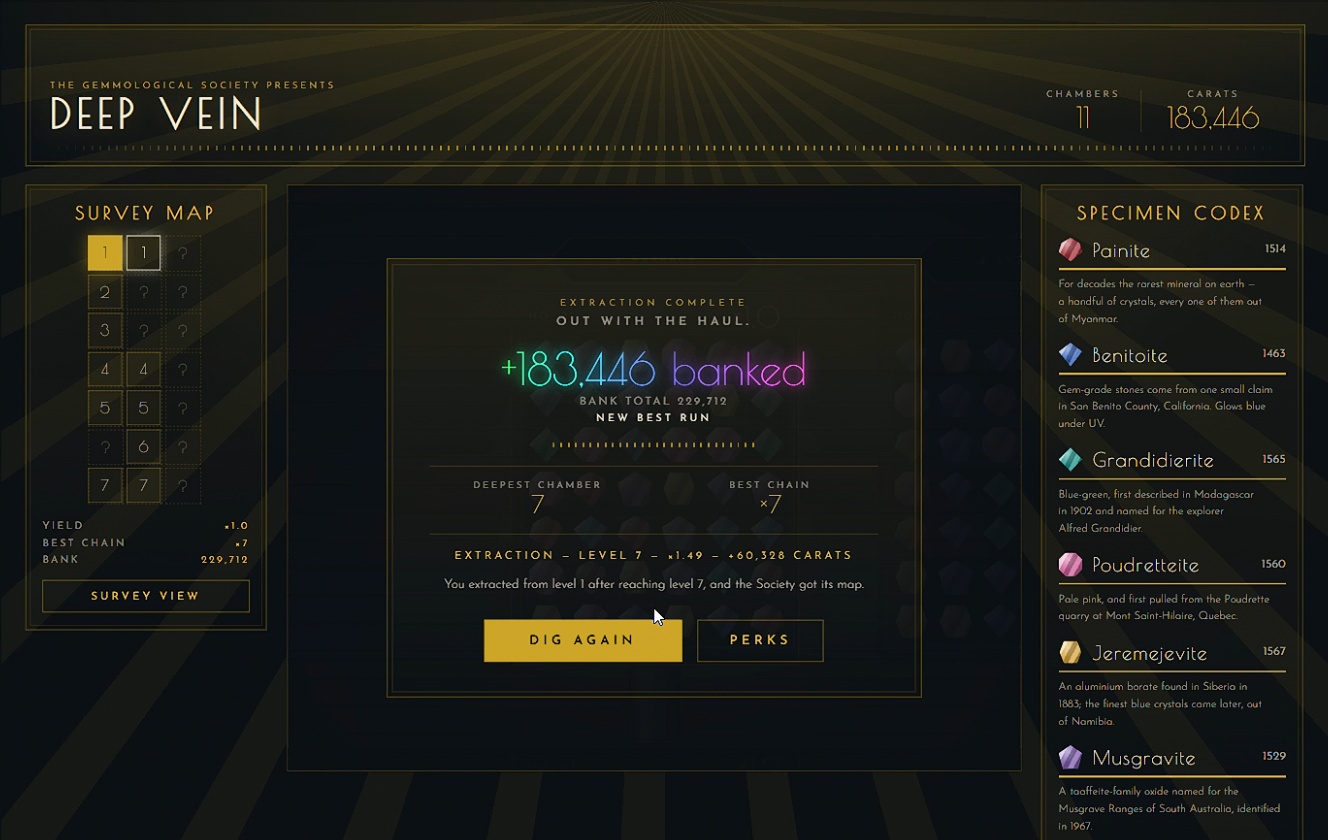
- Explore deeper or go back to surface to extract haul (Earned Carats).
5. Spend currency on perks (skill tree)
- Upgrade perks to aid your next run
6. Next Run
- Return to a new run to collect more gems
This is an experimental prototype. All presentations are work in progress.
Drop me an email if you want to try a demo.
Match-3 Boards in a Dungeon Layout
Design Goal:
- Keep the classic match-3 experience.
- Replace the linear level structure with a replayable roguelike run.
- Keep it fast paced.
The Problem:
- Classic match-3 games uses a large board, such as 8x8 / 9 x9, which plays like a puzzle. The player scores until they run out of moves or time, then moves on to the next level.
- Existing match-3 roguelikes often redesign the core gameplay until matching is just a flavour.
Decision 1: One board = one chamber
I Borrowed the dungeon structure from traditional roguelikes.
- I chose 6×7 board to keep matching and discovery pace fast because each chamber is one room, not a whole session.
Decision 2: Procedural dungeon = multiple connected chambers
Each run should feel like a new map with something to discover.
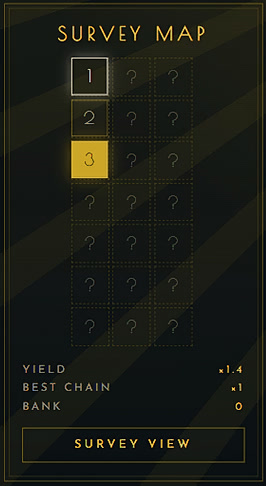
- Each run generates a hidden, connected layout of 10 to 14 chambers. It gives the player something to explore but not dragging the run.
Building the design intent behind the dungeon experience
My intention is for players to feel motivated to explore the unknown on each run. Each run should feel like a new map and have new discoveries to make. So, each run generates a different, hidden, connected layout made up of multiple chambers.
How can I then motivate the player to explore, make meaningful decisions to match combinations strategically and traverse the map to uncover the hidden layout?
MAP (v1): The whole dungeon is shown as a mini map from the start.
Exploration became a checklist:
- match toward the known edge,
- unlock a chamber,
- move on.
MAP (v2): Kept the layout unknown but not hidden.
Now, the player no longer knows if the next breach opens a room or a dead end, which makes going one chamber deeper a decision instead of a checklist item.
NAVIGATION: I ended up with this decision:
- Matching 3 or more gems along a chamber's edge unlocks access to the neighbouring chamber.
While this is a new piece of game language the player has to learn, the intent was to tie navigation to the core mechanic. The player never leaves the match-3 experience as they explore. Choosing which edge to match toward is the player's exploration decision to make.
EXPLORING: I decided to keep explored areas legible. The point was for the player to make meaningful decisions. The map should be a tool to aid the player to act on what they have explored and to align where they are in the dungeon.
A mode that hides the map could be added later as a challenge mode, but the base game will not include it.
Building the Risk & Reward Framework
The Problem:
With no risk or cost to exploring, the dungeon layout is just a bigger board.
How could I make exploring the dungeon more exciting?
Decision:
I needed to create a risk and reward system within the run.
1) Constraint: Control the pacing
I needed to add time as the core constraint. But time alone only makes a player rush.
2) Risk: Create inherent risk
I needed a way to push the player to take extra risks, moving towards the unknown instead of matching safely in one chamber.
3) Reward: Breadcrumbs for air and multipliers
I needed to entice the player with the promise of the big reward on taking the risk.
Making each run into a push-your-luck loop
An exciting game needs high tension.
How could I make players actively choose, creating tension by balancing greed against caution?
They decide whether to bank what they have earned or risk it for more.
Going deeper is risky, so rewards are needed to sweeten the deal.
I made every extra step both more rewarding and more dangerous.
Every time a chamber is found, it adds a little air, enough to justify one more push. These small refills act as breadcrumbs to lure the player to take the risk to explore more.
I also added a multiplier for matching combinations in deeper chambers. Every step deeper makes each combination reward higher.
Finally, a depth multiplier would be applied on everything already collected at the end of each run that would drastically boost the rewards earned in that run.
Getting the haul out of a run is a required action.
I wanted the player to feel the tension as they push deeper, raising their risk with every extra step, while weighing they can make it back to the surface in time.
This push-your-luck loop means every successful run ends with a strong sense of satisfaction that brings the player back for another.
If failing a run meant losing every reward, the loss aversion effect could make the game feel too punishing overall. Instead, the player bleeds rewards for every second past zero until they extract.
The intention is to soften loss aversion while keeping the tension high and pushing the player to extract as soon as possible.
Perks: A Reason for the Next Run
The Problem:
Each run now has exploration, tension and a payout.
What would bring the player back for another run?
Decision:
Players needed an objective that unlocks more content, and a way to spend the carats they earned after each run. I needed a progression system, so I built a perk tree.
I want players to achieve mastery and full completion in their runs, uncovering all chambers to be discovered and discovering all gems to be discovered.
So, I focused on what gives value to the player.
Perks make a run easier to survive, longer to explore and better equipped to perform better in a new run.
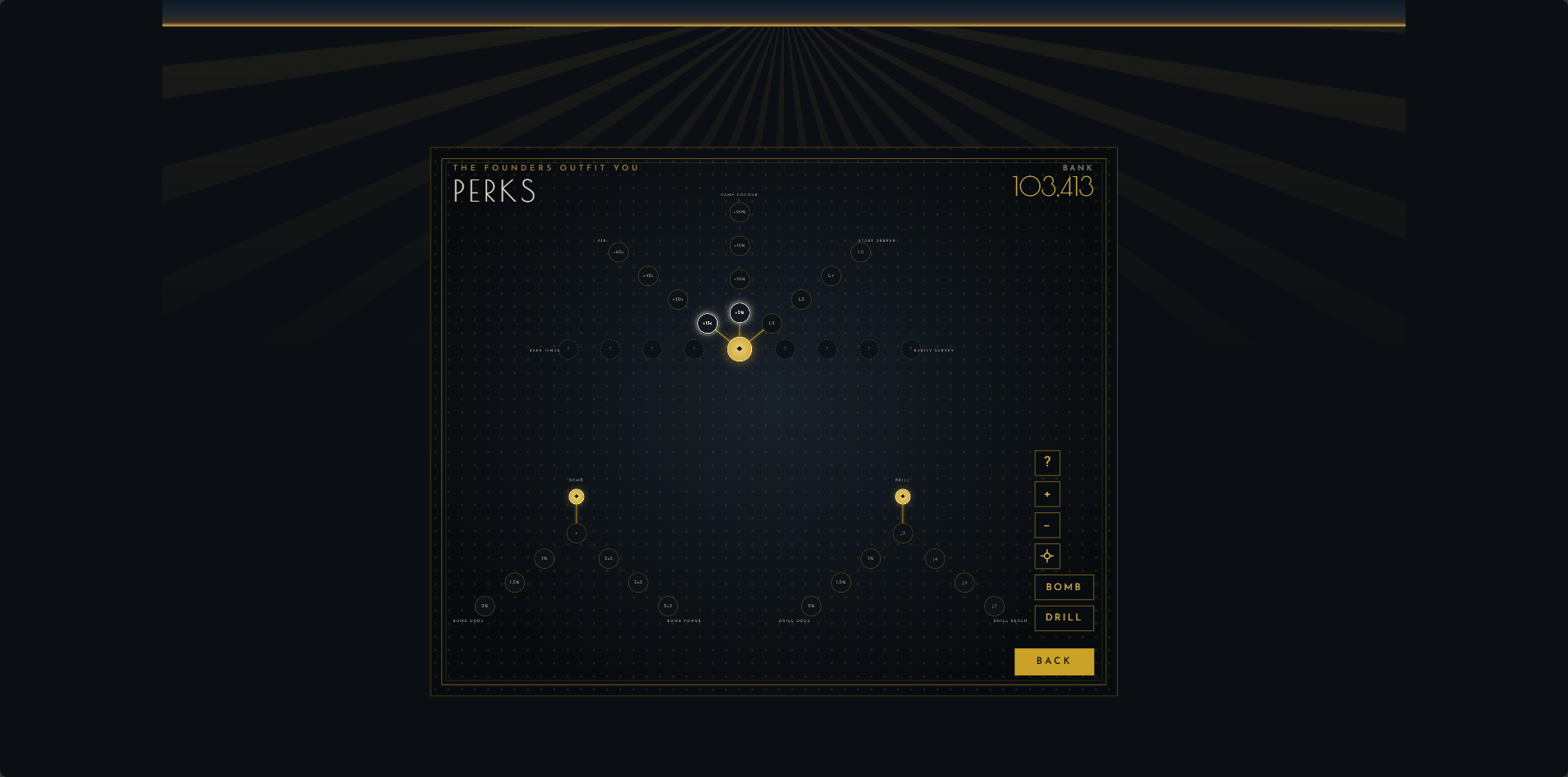
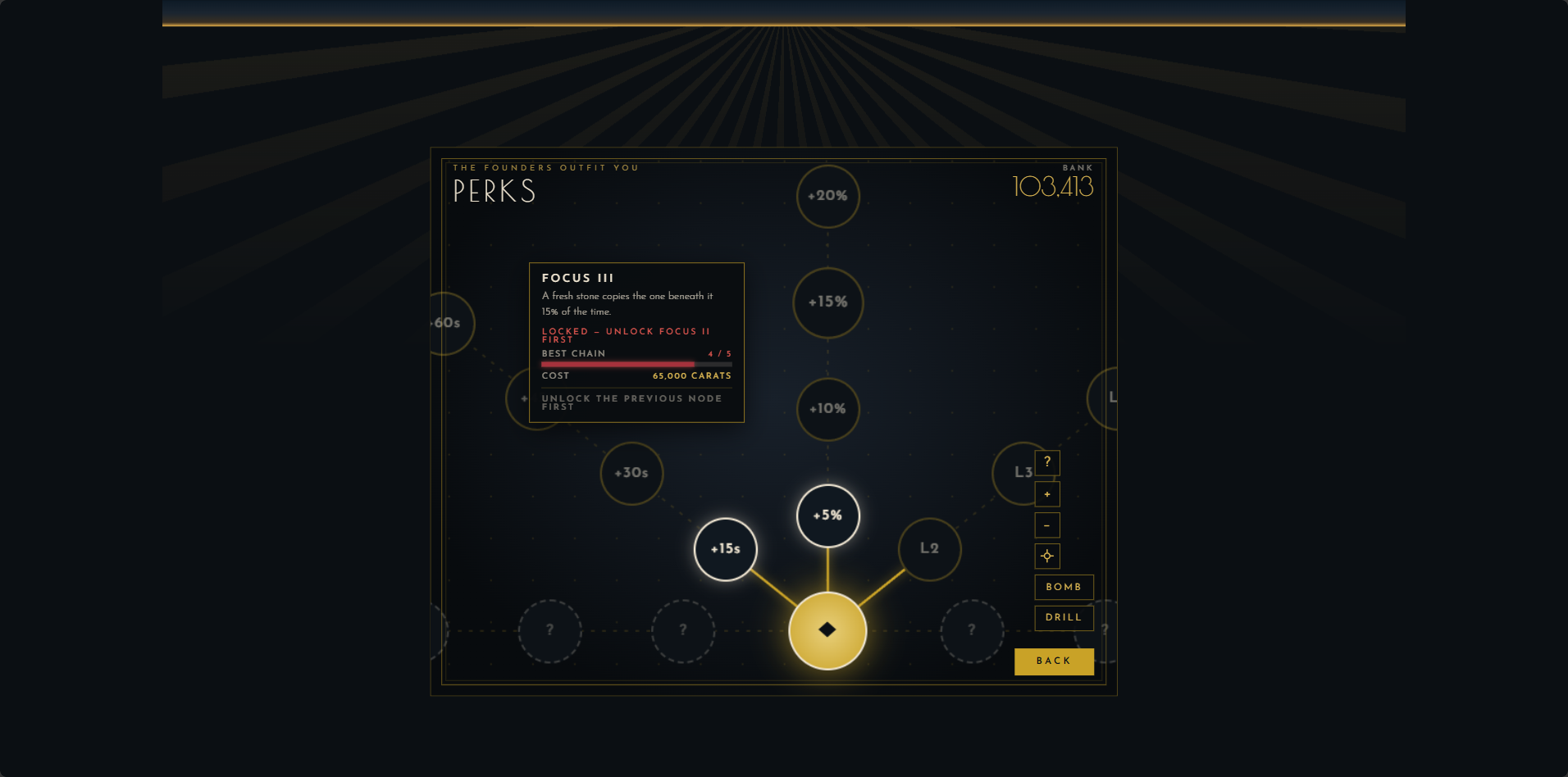
What each perk does?
Each perk act as a meta progression for the player to find ways to perform better in the next run.
Air
This perk adds bonus starting air. Useful for lasting longer in each run.
Start Deeper
Begin on deeper chambers above already charted.
Same-Colour
makes same colour jewels more likely to spawn, leading to easier chain combos.
Bomb
Spawn a volatile tile that clears the surrounding radius. Branches out with trigger odds and extended radius.
Drill
Spawn a volatile tile that clears tiles in a downward vertical direction. Branches out with trigger odds and extended vertical distance.
Rare Finds and Rarity Survey
Makes rare jewels more likely to appear. Locked, with no effect yet.
Determining requirements to unlock a perk?
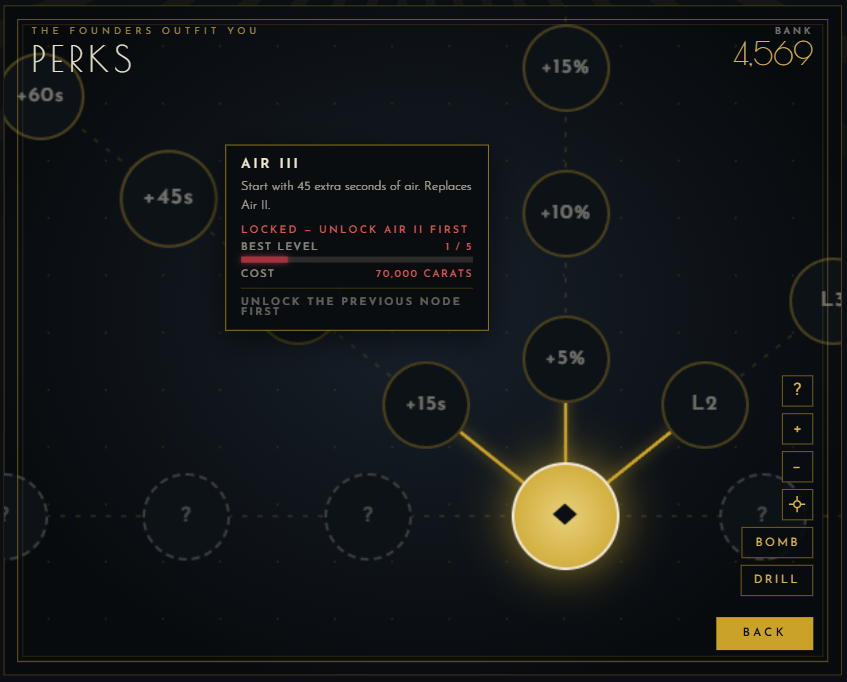
Carats decide how fast a player can buy. Prices per perk starts easy from 15,000 to 160,000 to pace out the purchases and how fast they can progress.
Additionally, I needed ways to stop a lucky run skipping ahead too much and buying out every perk upgrade there is to offer.
An example for a perk like [Air III] that not only costs 70,000 carats,
it has a pre-requisite for player to have at least achieved a depth of level 5.
This helps to manage the minimum objective a player needs to make that are not necessarily achievable in a single run all the time.
How far can perks improve the run?
With the values determined by how long I intend a session to last, I needed to determine first if the perks affect the run at all, or that it would give the player too much boost.
Either would mean the perk system has failed.
So, I wanted to measure how much difference would perks bring, and to measure how would an average life-run turn out.
1) The game starts at 60s/run. one with no perks, and one with every perk maxed.
Simulated at 1000 runs each.
2) The other is a simulated progression of buying perks between runs, starting from the cheapest first, until the perks are full purchased.
The charts are simplified as it shows the median performance of run(s)
Average Run:
- With no perks an average run banks about 29,300 carats and lasts 115s on average.
- With max perks an average run banks about 92,900 and lasts 141s on average.
- 3.2x improvement for earned carats and 1.23x time increase per run.
Average Progression:
The line curve of accumulated runs is also seen to progress up steady, which is what I want.
This makes every few runs the player can feel the game opening up and takes about 25 runs to unlock all perks currently.
I could be looking at measuring every perk individual performance to test for under/over performers.
That would lead me to determine my next steps of which perk values and pricing need rebalancing to make sure that each individual perks are equally beneficial but choosing the combinations would be the interesting decisions to make to improve performance.
Balancing the Economy
Having currency and upgrades means there is an economy to balance. It affects every decision made and requires a lot of iteration. As it is a huge topic to cover so I am going to just describe the broad aspect of my process.
Approach:
- Intent first: Translated design goals into testable questions
- Isolate, then integrate: Balanced each system on its own, then simulated the combined economy to catch interactions that only appear together.
- Exploit-proofing: Ran simulations targeting extreme builds and formula edge cases to make sure no run could be broken by an overlooked combination.
Simulating a run:
With many random variables at play, it is obvious luck would be wide.
But the variable I can control is speed and I can measure the spread.
Hence, the simulation plays runs on a few simple rules:
- How long the player think/move
- Takes the first match it finds, no strategy
- Turns back to level 1 for extraction when air left 6s by default
Main factors that affect the whole balance:
- Time
- Payout values
- Perk progression
Below, I share my 3 tests process and findings:
1) The starting air timing
2) payout formula
3) which perks earn their price
Test 1: The starting air time
Air is the core constraint, so the starting number sets how hard the first runs could feel.
Design intent:
Use a start time short enough so the player can feel a risk at the back of their mind.
The question:
Would the time be too long when perks and unlocked chamber's bonus air come into play.
Does a short first run affect progression? (Comparing 60s start time vs 30s start time)
Early Game
For starting at 30s, a no-perk run last 86s vs 131s when starting at 60s
Endgame
The two lines seem to converge by 21 to 25 runs both sit near 155 seconds
The findings show a stable shrink in the gap based off the two different starting baselines.
This means the starting base time can be set at any amount and does not affect the perk system.
Buying the whole tree takes about 27 runs at a 60s start and about 32 at 30s, and both come to about 81 minutes of play.
Test 2: The extracting carats formula
When coming up with a reward formula for successfully extracting the carats in the run, I initially wanted to reward a player for managing their time well who makes it home with air to spare.
In the initial design for the payout reward formula, a parameter of time left was used to calculate:total earned carats = carats × (1 + time left × depth level uncovered × rate)But I noticed a possible exploit that players can still get a similar reward rate even if the player played safely.
My hypothesis:
I suspected that a player could play very safe and extract early, or play risky and extract at the last moment, and get a very close payout reward and that the "time left" was causing the issue.
So, I decided to remove "time left" for the new formula to make the comparison.
- Old formula: safe and risky playstyles were almost the same, at a 2% difference so the exploit is real.
- New formula: playing safe does not pay well and working as intended.
- The old formula (Grey line) makes the curve flatter. It didn't matter too much if the player was playing safe or risky.
- The new formula (Gold line) shows that the safer you play, the worse your score would be.
Hence, the new formula has reflected the intended design intention for rewarding more when a player takes more risk.
Test 3: Measuring best/worst performing perks
The question:
All perks are not made equal. Some may be better than the other. I needed to check how the perks fare in a simulation test. That would better inform me whether to change a perk's effect or its price.
How the simulation runs were tested:
- The simulation tests the run with only one perk bought.
- If the perk needs earlier steps to unlock, those were bought too.
- Compared the carats banked against a run with no perks.
- Divided that gain by the perk's cost, so cheap and expensive perks can be compared fairly.
- Simulated 1,000 runs per perk, at a 60s start.
What is "luck" here?
As there is a high random variability in the game, a no-perk run can bank anywhere from 8,000 to 52,000 carats.
Averaging 1,000 runs smooths that out, but the average still moves by about 2% between tests.
So, a perk that gains less than 4% might only be caused by the variability and not absolute.
The line on each bar is the range the true gain most likely falls in (95%). If it reaches zero.
Best value:
- Air I give +17% for 15,000 carats, the best return of any perk.
- Air II and Deeper I as well.
The first upgrade of a branch is always the best value gain.
Later upgrades give lesser beneficial gain:
- Air, Deeper, and Focus perks upgrades underperform as compared to its earlier tiers.
Bomb and Drill performed poorly:
- 12 of the 14 perks in those two branches gain less than 4%, and several sit slightly below zero.
- Only Bomb Power III (5x5) and Drill Reach III (down 7) clear it, at +6% and +9%.
Things to keep in mind:
- The simulated player only scans for a swap match. It does not look for or perform strategies.
- Each perk was tested alone. Bomb and Drill might work better when bought together.
- While spawning Bombs and Drills are still random, it is still a highly player dependent, a real player might be better in strategies to get bombs and drills to perform much better.
While not absolute, I have a better understanding of where each individual perk stands in game now.
I would adjust the values of the perk before adjusting the cost.
Where it is now, and what's still open
The prototype was built as a challenge for me to test a question in mind and have helped me explore the experience I was building towards. It has achieved its intention as a functional prototype demo.
The open question
How well would it be received among players?
What's next?
To take it beyond a functional prototype,
- visuals and UI polish,
- new content for maps, jewels and skill trees,
- overall progression balancing,
- playtest feedback.
UI Update:
The current prototype version focuses on game functionality.
To bring it to the next level of polish, the UI will need an update.
The current UI was only made to be functional enough to test ideas and not necessarily best fit to the whole game experience.
New Content:
- New Maps
Adding new maps to explore new ways to define layouts and difficulties. Adding new modifiers that is unique to the map to provide new challenges.
- New Jewel types
Jewels are supposed to be expanded to an encyclopedia for the world's jewels discovered.
Balancing progression:
- Balancing values that affect Time. Ultimately affects the overall progression of the game.
- Balancing Perks through unlocking requirements, adjusting cost and value upgrade per tier
- Polishing the second-to-second pacing and run-to-run grinding for progression.
Playtest:
There are limitations to simulators.
To know how good the game is working as intended would need actual players testing.